Most adventure travel activities are designed around verbal instruction. The guide explains the technique. The instructor calls out corrections. The safety briefing is delivered in spoken language, with written notes or an interpreter as an afterthought if the operator has thought about accessibility at all. For deaf and hard of hearing travelers, this creates a consistent friction: the activity itself may be fully accessible, but the instruction and safety systems around it are not designed with them in mind.
Horseback riding is a meaningful exception. The primary language of horsemanship is not spoken. It is physical: the distribution of weight in the saddle, the pressure of the leg against the horse’s side, the tension or softness in the reins, the posture of the rider’s spine. A horse does not hear its rider’s voice as the main channel of communication. It feels the rider’s body. This makes horseback riding one of the few adventure activities in which a deaf or hard of hearing participant is operating on exactly the same sensory terms as a hearing participant, and in some cases may be at an advantage, having developed a sharper attentiveness to non-verbal physical cues through daily life in a hearing world.
Kauai, Hawaii’s most naturally preserved island, provides one of the most scenically and ecologically rich settings for this experience anywhere in the Pacific. Here are eight reasons it belongs on the deaf traveler’s list.
1. Horse Communication Is Entirely Non-Auditory
A horse’s primary sensory channel for receiving rider communication is touch. The horse reads the rider’s seat bones and how their weight shifts between them. It reads the contact of the inner leg against its barrel. It reads the softening or firming of the rein connection through the bit. It reads the rider’s breathing, tension, and posture. None of these signals are auditory. A deaf rider communicates with a horse through exactly the same physical channels as a hearing rider, and the horse makes no distinction.
This is not a minor accommodation. It is the fundamental architecture of the activity. The voice commands that some instructors use (walk, trot, halt) are supplementary to the physical aids, not primary. A well-trained horse will respond to physical aids regardless of whether the rider has spoken any words at all. For a deaf rider who has been accustomed to arriving at new activities and immediately asking “how will I receive the instructions?”, horseback riding is the activity where that question largely answers itself in their favour.
2. Equine-Assisted Therapy Research Supports the Benefits for the Deaf Community
Equine-assisted activities have been studied for their therapeutic and developmental benefits across a range of populations, and the research on deaf and hard of hearing participants specifically has produced consistent findings: horseback riding improves vestibular function, balance, and proprioception in ways that are measurable and that benefit populations whose sensory integration patterns differ from hearing norms. The rhythmic movement of the horse at walk produces sensory input that mirrors the gait patterns the human body is calibrated for, producing relaxation, improved posture, and in therapeutic settings, measurable gains in motor coordination.
For children who are deaf or hard of hearing and who may also experience balance and vestibular differences as a secondary effect of inner ear differences, the proprioceptive input of sitting on a moving horse has been documented as a useful intervention. For adult deaf travelers, the same vestibular engagement produces the deep physical relaxation that makes a two-hour trail ride on a well-trained horse one of the most restorative physical experiences available without specialist therapeutic equipment.
3. Kauai’s Trail Landscape Is a Feast for the Senses That Hearing Is Not Required to Access
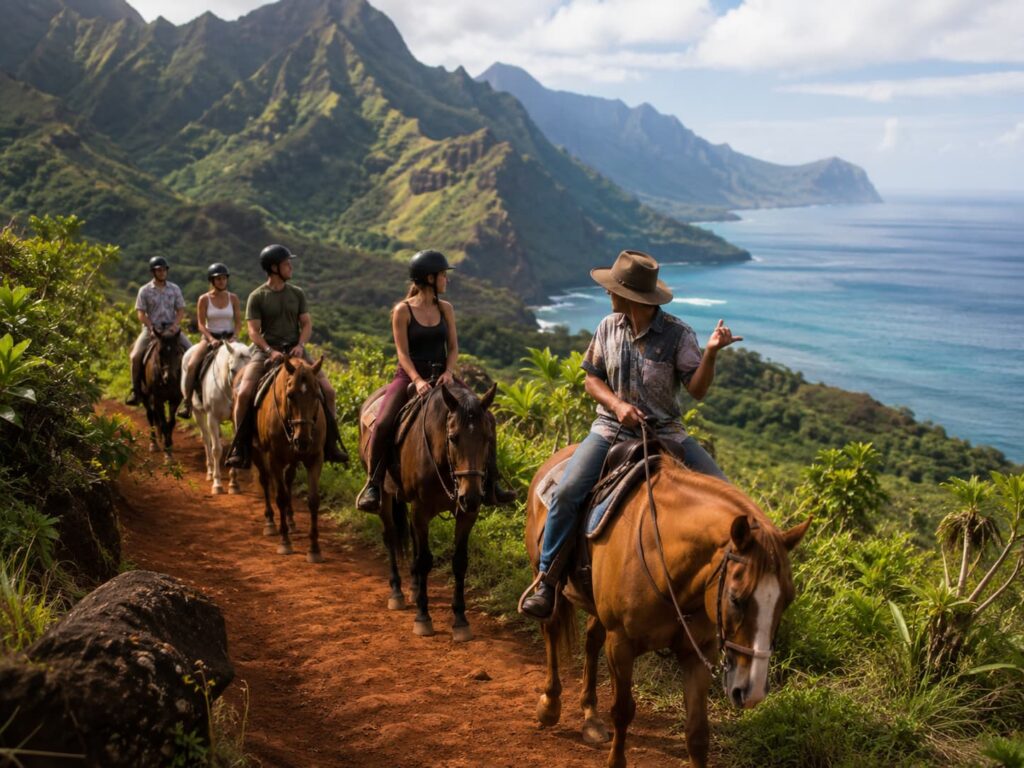
The horseback riding trails on Kauai move through terrain that is visually and physically rich in ways that do not depend on sound to appreciate. The Na Pali coast views from the elevated trails on the island’s north and west sides. The colour of the volcanic red soil against the green of the vegetation. The feel of the trade wind coming off the Pacific. The horse’s movement changing as it moves from open pasture to forest trail to cliff-edge viewpoint. The temperature dropping as you move into the shade of the tree canopy and rising again in the open.
For deaf and hard of hearing travelers who experience the world through heightened visual and tactile attention, a landscape as physically and visually dense as Kauai’s delivers an experience that is, in significant ways, more completely available to them than to a hearing traveler who is processing the same scene through a divided sensory channel. The birdsong is not irrelevant, but it is one layer of many, and the other layers are fully present.
4. Pre-Ride Communication Can Be Fully Managed Through Visual and Written Channels
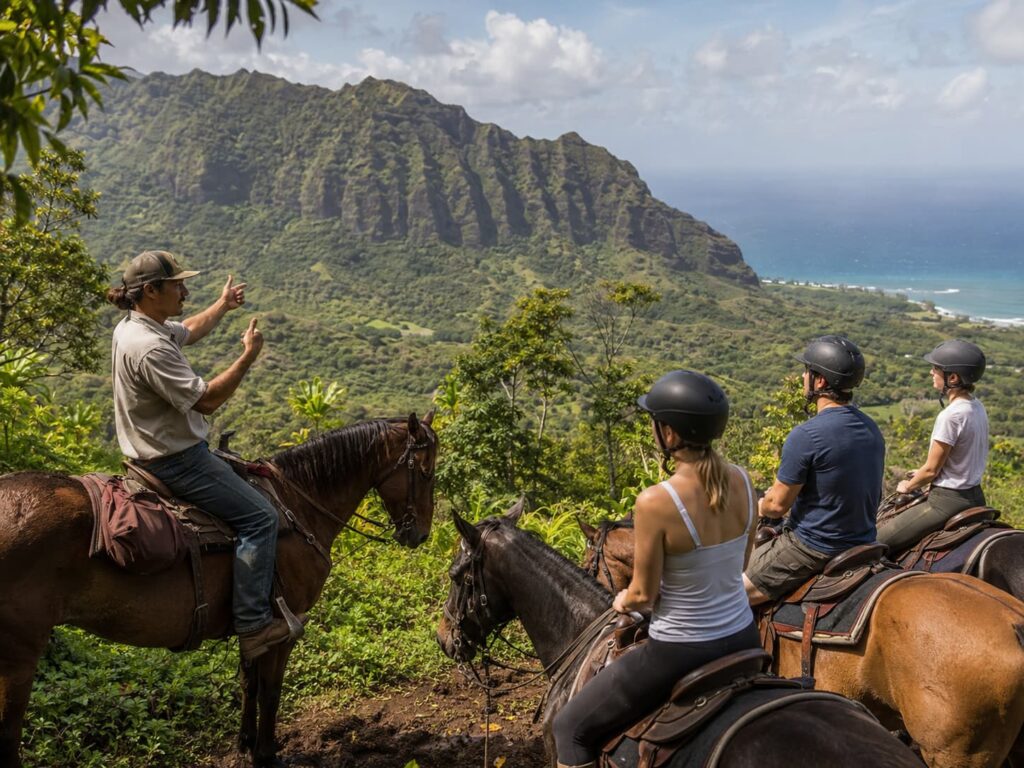
The safety briefing and riding instruction that precede a trail ride are the primary point at which hearing-centred assumptions create barriers for deaf participants. On Kauai, where the riding operators work with a regular stream of international visitors across many languages, written instruction, demonstration-based teaching, and visual safety briefings are standard rather than exceptional practice. The instructor demonstrates the physical position and the aids before the ride begins. Written safety cards are typically available. For participants with an interpreter or who communicate in ASL, the briefing environment is manageable in a way that a rapid-fire verbal briefing in a noisy stable yard is not.
Deaf and hard of hearing riders who communicate their needs in advance typically find that Kauai’s riding operators are accommodating, partly because the demonstration-based teaching method that works best for deaf participants also happens to be the most effective teaching method for any new rider, hearing or not. Showing someone the correct leg position is more effective than describing it in any language.
5. The Landscape of Kauai Communicates Without Words
There is a specific quality of attention that many deaf and hard of hearing people develop through navigating a hearing world: a heightened awareness of visual space, of changes in light and shadow, of the physical details of the environment that a hearing person might process as background while their primary attention is on sound. In a landscape as visually dense and changeable as Kauai’s, this attentional quality is not a compensation for anything. It is an asset.
The light on the Na Pali cliffs at different times of day. The colour gradient of the water visible from the coastal trail viewpoints, from dark blue offshore through turquoise over the reef to white where the swell breaks on the rocks. The haze that settles in the valleys in the morning and burns off by midday. A deaf rider who notices these things from the saddle without auditory distraction is experiencing the island in a way that is complete in itself. Travel literature about Kauai is full of descriptions of its visual beauty. That beauty is entirely accessible to the deaf traveler on horseback.
6. Guided Horseback Tours Provide the Structure That Makes the Experience Safe and Enjoyable
Trail horses on guided tours are specifically trained for the patience, consistency, and responsiveness that beginner and occasional riders require. They are matched to rider experience level, follow established routes at managed paces, and are handled by guides who are trained to monitor both the horses and the riders for signs of discomfort or difficulty. For a deaf rider on a new trail in an unfamiliar environment, having a guide present who can communicate directly and who understands the horse’s behaviour removes the uncertainty that independent riding in an unknown landscape would introduce.
Operators like Kauai Horseback Tours offer guided trail rides across the island’s key landscape environments, with horses matched to rider experience and guides who accompany the group throughout. For deaf and hard of hearing riders who want to discuss their communication needs before booking, the direct pre-booking contact that guided tour operators provide is the opportunity to confirm that the visual and demonstration-based instruction style is in place and that the experience will be managed with their needs understood from the start.
7. The Hawaiian Cultural Context of the Ride Has Its Own Non-Verbal Depth
The history of horsemanship in Hawaii has a specific cultural dimension that is worth knowing before you arrive. Horses were introduced to Hawaii in the late 18th century and were adopted by Hawaiian cowboys, called paniolo, who developed a distinctive riding and ranching tradition on the island’s large cattle ranches. The paniolo tradition, which drew on Mexican vaquero technique brought by Spanish cowboys hired to train the Hawaiian workforce, produced a horsemanship culture whose techniques and values are still visible in the way horses are handled and ridden on Kauai today.
This cultural history is conveyed not primarily through verbal explanation but through the physical practice of the ride itself: the way the horses are handled, the equipment used, the relationship between the guide and the horses on the trail. For deaf riders who receive cultural information through observation and physical participation rather than through narrated tours, this layer of meaning is as available to them as to any hearing participant. It is embedded in what the guide does, not only in what the guide says.
8. The Combination of Physical Activity, Nature Immersion, and Non-Verbal Communication Makes Horseback Riding Uniquely Restorative
Research on the wellbeing of deaf and hard of hearing individuals consistently identifies the effort of communication in hearing-dominant environments as a significant source of fatigue. Navigating spoken conversation, lip-reading, managing interpreters, and operating across language access gaps that hearing people do not notice requires sustained cognitive effort that accumulates across a day and across a life. Activities that offer genuine rest from that effort, not by removing social interaction but by grounding it in a non-auditory channel that does not disadvantage the deaf participant, tend to restore more than the hours spent on them might suggest.
A two-hour trail ride on Kauai provides exactly this: physical engagement, social presence (the guide, other riders, the horse itself as a social partner), and natural environment immersion, all in a framework where the primary communication channel is physical and the playing field is level. The broader conversation about how education for the deaf and hard of hearing can be improved through multi-sensory approaches applies equally to travel and leisure: the experiences that work best for deaf participants are often the ones built around non-auditory communication channels from the ground up. Horseback riding is one of them, and Kauai is one of the most rewarding places on earth to experience it.
For deaf travelers who are also interested in how technology is changing the communication landscape, the growing use of real-time captioning, translation apps, and visual alerting systems in tourism contexts is worth exploring before any trip. Our piece on how AI can bridge the deaf and hearing worlds covers some of the tools that are making hearing-centred environments more accessible, including in travel and hospitality settings where deaf visitors have historically had to advocate loudly for basic access.
A Final Thought
The best travel experiences for deaf and hard of hearing people are not the ones that have been adapted to include them as an afterthought. They are the ones where the activity’s core mechanics make them full participants from the start. Horseback riding is that activity. The horse communicates in a language that has no spoken component, and a deaf rider who pays attention to their body, their balance, and the animal beneath them has everything they need to have a complete experience.
Kauai provides the landscape. The horse provides the communication channel. The rest of it is the trail, the light on the cliffs, the trade wind, and the particular quality of presence that comes from moving through a beautiful place on an animal that is paying attention to exactly the same things you are.