Picture this scenario. You’re part of a rich, vibrant culture and community, but constantly confronted with an invisible barrier – the inability to communicate seamlessly with the world around you. The experience of deaf individuals has been defined by these barriers, with technology providing some solutions but mostly just workarounds.
Now, imagine this reality breaking apart as Artificial Intelligence (AI) steps into the landscape. Far beyond just being a tool, AI has begun to reshape accessibility, ensuring integration rather than mere accommodation. The goal is not just to offer assistance but to empower those who experience hearing loss. By fostering a greater sense of independence, this AI revolution is truly creating a world where we all speak the same language of shared understanding.
Deeper Than Transcription: AI’s Multidimensional Assistance
AI tools doing more than mere transcription? Yes, that’s the reality. A more sophisticated speech-to-text isn’t the end game. Built on advanced AI models, these tools are stepping up their game, offering more nuanced support for the Deaf community.
The accuracy of voice data interpretation is getting sharpened, making way for clearer communication. Simultaneously, multiple speakers can now be handled effortlessly, eradicating the confusion caused by different voices overlapping. The previous systems faltered at this hurdle but recent developments shine with promise.
Accents and speech patterns present another challenge, one that’s being tackled head on. AI is adapting, learning the rich tapestry of accents, dialects, and unique speech idiosyncrasies.
Transforming AI isn’t just reactive; it’s not just about tagging along with conversations and providing transcriptions. No longer a mere bystander, AI is becoming more proactive, providing intelligent communication assistance, delivering richer cues and context. We’re not talking about replacing human interaction. Instead, this evolution signifies the shift towards an AI that complements, amplifies and enriches the communication experience for those with hearing impairments.
The takeaway is this: AI technology for the Deaf community is not settling for the status quo. Its ambition stretches far beyond simple captioning, aiming for meaningful inclusion and interaction. There’s much work ahead, but we’re clearly moving in the right direction.
Instant AI Translation: Tearing Down Language Barriers
- Ever sat in a lecture or meeting wishing for live transcriptions? AI has it covered with applications like Google Live Transcribe and Ava that provide real-time transcriptions.
- Sign language conversation faces no roadblocks either. AI-powered sign language translation, through capturing motion to convert into text or voice, helps cross that bridge.
- Digital content isn’t lagging behind. Text-to-sign language avatars are paving the way for inclusive digital communication.
- Visual sound alerts, like smart home devices detecting alarms, provide modern solutions for traditional challenges. It’s the power of AI, amplifying the security and convenience at home for the Deaf community.
AI translation applications are not just about bridging language gaps, they’re aimed at tearing them down, making communication smoother and more efficient for everyone. As technology continues to evolve, the promise of a barrier-free future grows stronger.
The AI Revolution in Deaf Education
Artificial Intelligence (AI) is quietly staging a revolution in the education sector, particularly for deaf students and professionals. Gone are the days when custom education for the deaf felt like an uphill climb. Learning environments are now being transformed by AI’s ability to provide personalized learning paths and interactive content.
Through AI-powered tools, deaf individuals can access information that was once arduously difficult to obtain. Take the example of an online educational platform optimised for the deaf – it does not merely caption the lectures but also translates the lecturer’s non-verbal cues into easily comprehensible instructions.
In this reimagined learning space, advancement in one’s academic or career path does not hinge on the limits set by auditory communication. AI, with its ability to decode and convey complex communication patterns, is levelling the playing field. Deaf students can now navigate their educational journey with fewer constraints and a heightened sense of independence.
This shift orchestrated by AI has more than just learning benefits. It heralds greater societal inclusion, ensuring that the pursuit of education and subsequent career progression is an equitable journey for all, deaf or otherwise. The significance of this contribution of AI cannot be overstated – it marks a turning point in the empowerment journey of the deaf community globally.
AI-Powered Aids for Learning and Communication
1. For deaf individuals and anyone seeking practical communication tools, AI has transformed basic note-taking into a high-tech, inclusive activity. A tool like Otter.ai, for instance, provides real-time transcription services, enabling users to follow lectures, meetings, and conversations, transcending auditory boundaries.
2. Meanwhile, Avaz AAC steps it up a notch, offering a communication aid that uses AI to predict the user’s input, making communication efficient and intuitive. From basic day-to-day interactions to expressing complex thoughts, Avaz AAC allows an unprecedented degree of linguistic liberty.
3. On the educational front, platforms like Edubrain represent a revolution in learning methods. When looking for a ChatGPT alternative for coding or hunting through the myriad of the best brain-training apps, such comprehensive platforms are often overlooked. Going beyond simple problem-solving, Edubrain separates itself from the best AI math solvers by not only providing answers but also breaking down methodologies. This functionality is especially helpful in specialized fields, where understanding the process is as vital as getting the correct answer.
AI transforms assistive technologies from merely pragmatic solutions into tools that empower self-sufficiency and independence. Today, deaf individuals can communicate, learn, and thrive with ease and efficiency, thanks to these AI-powered tools.
Weighing AI Accessibility: Gratifications and Challenges
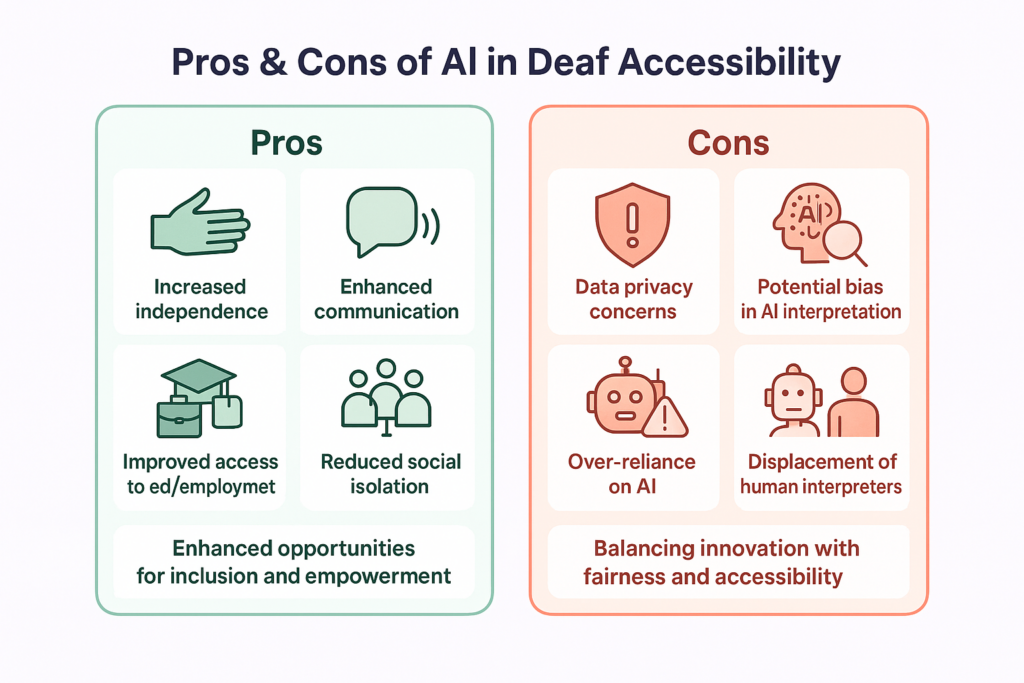
Choosing to harness the power of AI for accessibility brings forth a spectrum of outcomes. Positive repercussions can be experienced in the form of increased autonomy, enriched conversations, easily accessible education and employment, and diminished societal isolation. However, before we proceed down this path of tech-enriched accessibility, it’s important to shine light on potential tribulations as well.
Advantages Increased Independence:
AI-powered technology allows the deaf community to communicate, learn, and navigate their surroundings independently. This fosters a sense of self-sufficiency, ultimately boosting confidence.
Better Communication:
Real-time transcription services, sign language interpreters, and predictive communication aids decrease reliance on human assistance, making communication seamless and efficient.
Accessible Education and Employment:
Tools like Edubrain allow individuals to understand complex concepts, thereby making education and job opportunities more accessible.
Social Inclusion:
By facilitating communication, AI aids in reducing social isolation experienced by the deaf community, fostering more meaningful connections and relationships.
Challenges Data Privacy:
AI technologies often require access to personal data. Without the right safeguards in place, this leads to concerns over data privacy.
Misinterpretation or Bias:
The risk of misinterpretation in conversation or bias in AI programming can never be completely eradicated, potentially leading to inaccurate communication.
Digital Divide:
Not everyone has equal access to emerging technologies, resulting in uneven benefits from these advancements.
Over-reliance on AI:
Dependence on AI technologies might inadvertently decrease human interaction and skills.
Job Displacement:
As AI takes over, human interpreters might face job displacement.
In weighing the merits and demerits of AI-enhanced accessibility solutions, we must remember to maintain a balanced perspective. As we unlock new ways of fostering inclusion, let’s continue refining the technology, addressing its pitfalls, and enhancing its capabilities to make a truly equitable society a reality.
Glimpses into Tomorrow: AI Accessibility for the Deaf Evolves
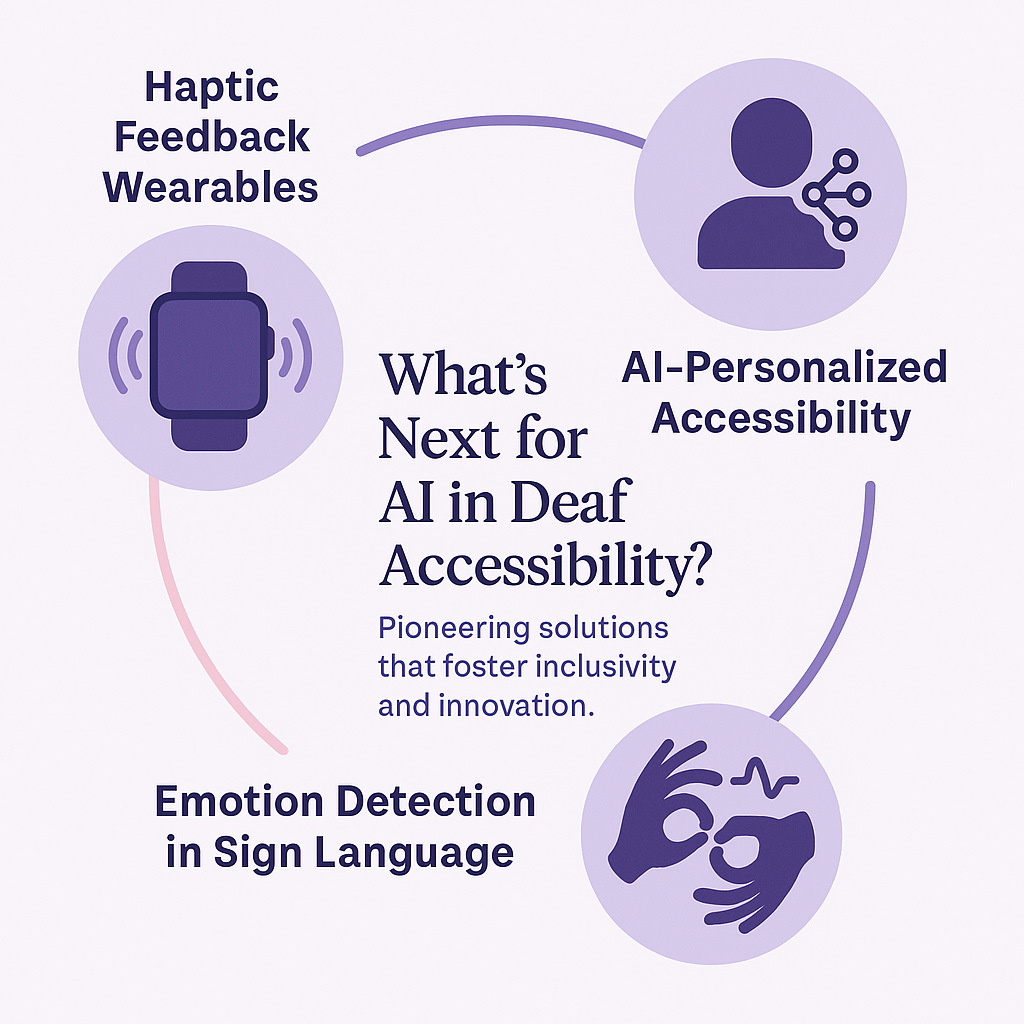
With the advent of sophisticated technologies like haptic feedback wearables and advanced emotion detection in sign language, the horizon of AI-driven accessibility for the deaf community extends further than ever before. These revolutionary advancements are not purely hypothetical, emerging from the realms of rigorous research and practical applications.
Thomas Bell, a leading advocate in accessibility tech, opines, “Deaf community’s involvement in shaping the technology is crucial. Their experience and perspectives bring us closer to building personalized accessibility solutions, powered by AI.” Imagine a world where a deaf individual dons a wearable that offers haptic feedback as a response to ambient sound. It could alert the wearer about a honking car or resonate with the rhythm of a favorite song.
In parallel, the potential for AI to recognize nuanced emotions in sign language takes communication to a deeper, more empathetic level. This technology could eventually eliminate misunderstandings and forge stronger social connections in the deaf community.
Bell continues, “What we foresee is the rise of AI-driven personalized accessibility profiles – the direct outcome of meaningful collaboration with the deaf community. These could evoke a paradigm shift in how we approach accessibility.” The deaf community, thus, stands not as passive recipients but as active contributors to this technological evolution. A truly accessible future lies just around the corner.
Drawing the Curtain: AI’s Pivotal Role in Inclusivity
As we close this exploration of AI and its formidable influence, let’s treat it not merely as a fix-it tool but as an exceptional agent of transformation. The pivotal role it plays in fortifying communication, augmenting education, and encouraging social integration for the deaf community points towards its potential. A future guided by AI promises to transcend conventional limitations, creating a sphere where deafness ceases to hinder comprehensive participation.
The underlying message here is one brimming with hope. The power of AI to architect a truly inclusive world is something both commendable and inevitable. Against the backdrop of such breath-taking transformations and evolutions, a significant revelation unfolds—the deaf don’t have a hearing problem; society has a listening one. AI lends us the ears to hear out this silent plea and the means to respond.