Picture this: a bustling conference room filled with passionate professionals, the buzz of conversation punctuated by bouts of laughter. But for one individual, their experience is eerily silent despite the resonating noise. As they lean forward, trying to decipher a flurry of fingers, they miss out on offhand comments and barely catch the gist of rapid-fire joking.
For those fluent in sign language, it’s a blessing.
However, it doesn’t always suffice, particularly during spontaneous interactions or large-scale professional gatherings. Imagine the dilemma during impromptu discussions at networking events or high-speed brainstorming sessions. The traditional models of communication, too often, leave someone out in the cold.
This is no small issue. It leaves members of the deaf and hard-of-hearing community grappling with a sense of disconnection and emotional fatigue, affecting both their personal relationships and professional growth.
Limitations of Traditional Methods: The Case for Immediate Interaction
While professional interpreters remain a crucial lifeline to the deaf community, several scenarios underscore their inherent limitations. A handful of these challenges are:
- Budget constraints and availability issues often limit access to interpreters, hindering equal participation.
- Spontaneous chats or informal banter at the water cooler become tough to navigate, leaving deaf individuals out of the loop.
- The logistics of one-to-many scenarios, such as public speeches or conferences, often lead to communication gaps despite the interpreters best efforts.
- Sensitive discussions might raise privacy concerns when a third party inevitably becomes part of the conversation.
- Lastly, enabling independent communication without a third-party cuts the strict dependency cord, granting individuals the autonomy they desire.
Each of these scenarios demonstrates the need for an innovative solution to bridge the communication gap in real-time, thereby fostering inclusivity in our diverse societies.
AI: A Beacon for Communication Accessibility
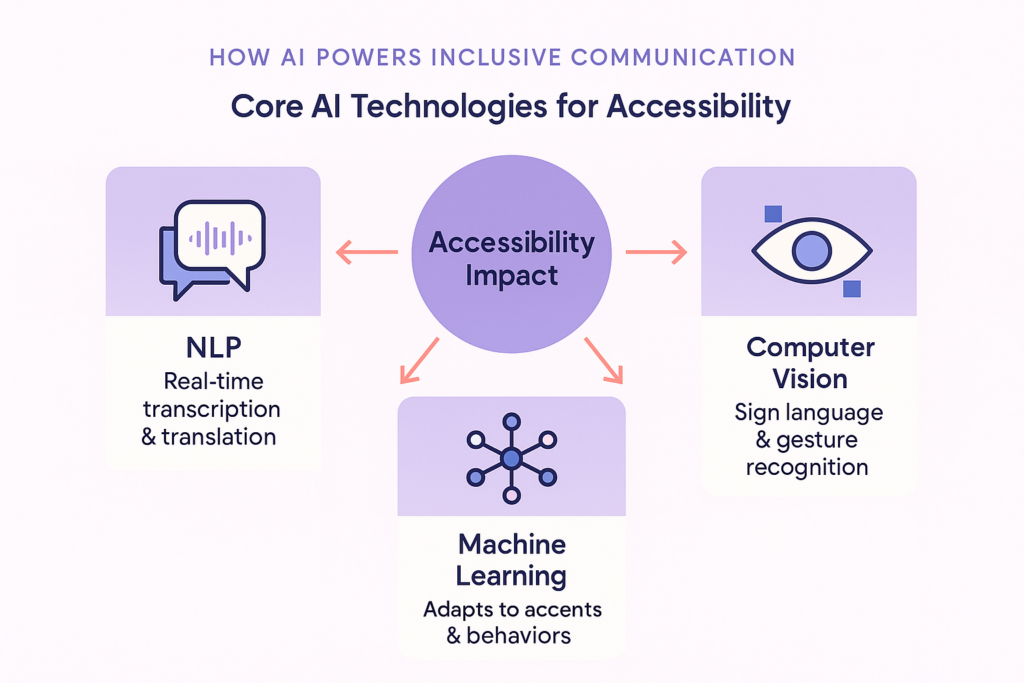
What’s unique about artificial intelligence, isn’t just that it enhances processes – it reimagines them entirely. In the realm of communication, AI excels by utilizing its ability to parse through colossal amounts of data, identify patterns, and learn from them, offering a fresh approach to decades-old barriers.
Neural networks and machine learning algorithms transform sign language into decipherable text, while Natural Language Processing (NLP) and computer vision are forging paths to real-time transcription and even translation of sign language. The fusion of these technologies presents a wellspring of opportunities to break down walls between different communication styles and create a more inclusive and accessible world for everyone.
Comparative Analysis: Real-time Captioning and Sign Language Recognition
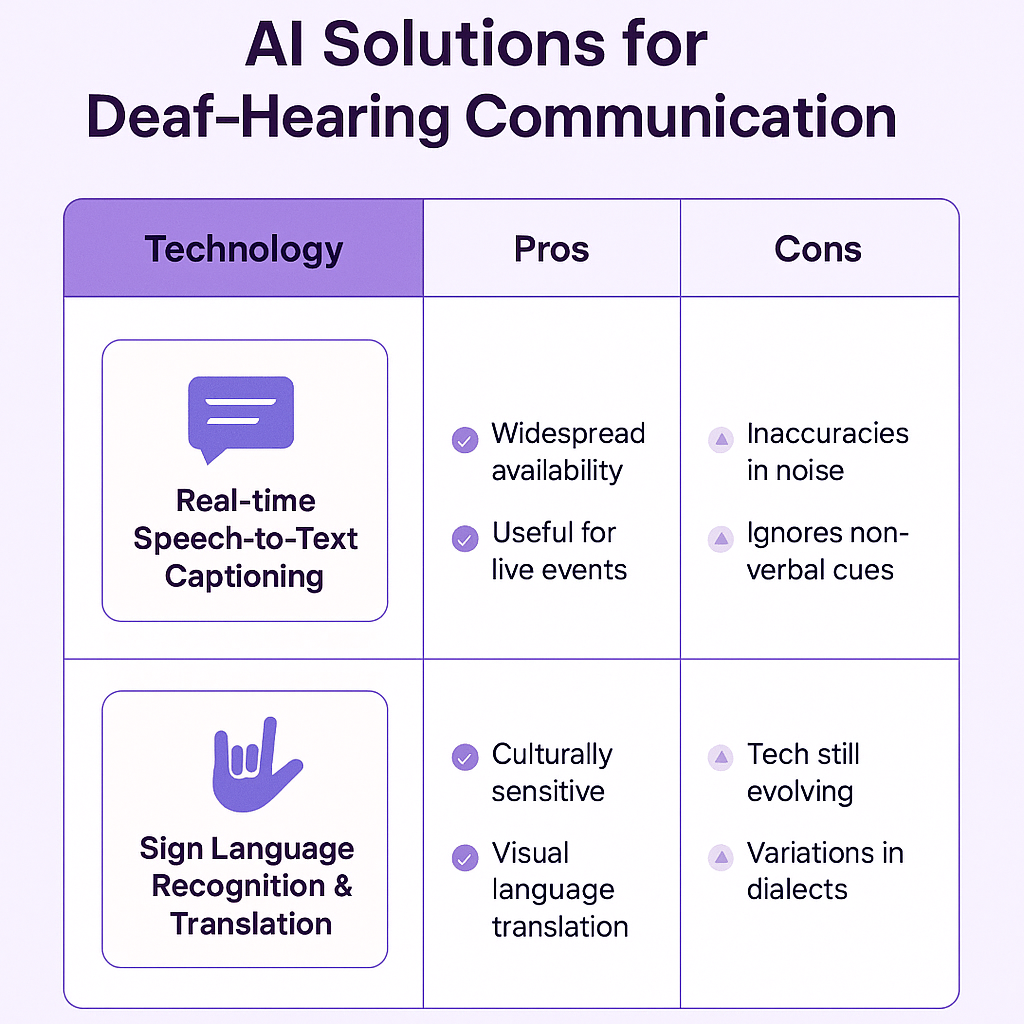
As we delve into AI’s role in communication accessibility, two primary approaches surface: ‘Real-time Speech-to-Text Captioning’ and ‘Sign Language Recognition & Translation’. Let’s dissect the strengths and weaknesses of each.
For ‘Real-time Speech-to-Text Captioning’, the upside comes in the form of its common availability and suitability for one-on-one conversations. That being said, its accuracy can dip dramatically in noisier environments. Besides, it often misses the nuances that non-verbal cues offer in conversations.
On the other hand, ‘Sign Language Recognition & Translation’ allows for direct translation of visual language, preserving the cultural integrity inherent in sign language. However, this process requires a significant computational load, and complications arise due to dialect variations in sign language.
Plus, it’s safe to say that this technology is still in its early days.
Balancing the potential of these technologies against their limitations, we can identify directions for further refinement and improvement. After all, the ultimate purpose is to eliminate any communication barriers, creating an equal platform for everyone.
Professional Opportunities Amplified: AI’s Game in Equal Access
AI offers intriguing possibilities in aiding deaf professionals to navigate the workplace more effectively, transforming how they participate in professional contexts like job interviews, team meetings, and networking events. Imagine a job interview where an AI-powered transcription tool provides accurate real-time captions, clarifying every word exchanged, every idea conveyed. Think of a virtual team meeting where an AI application recognizes and translates sign language in real time, fostering an environment of true inclusion.
These potentialities are bringing LinkedIn and other professional platforms that extra mile closer to becoming more equitable spaces. With AI technologies integrated, these platforms aren’t just amplifying communication. They’re changing the face of professional networking – making it more inclusive and diverse, leading to a rich repository of ideas and opportunities, where everyone participates on equal footing. Needless to say, getting to this point of seamless interaction is the key to bridging the deaf and hearing worlds.
Imagine attending a networking event armed with wearable tech powered by AI, which translates sign language or speech to text on the fly. Such solutions are turning traditional hurdles into gateways for interaction and understanding, representing how AI has a profound impact on inclusion and diverse talent acquisition.
AI technologies are not merely tools; they’re bridges leading us towards a world where every professional, irrespective of their hearing ability, feels empowered and included. That’s when we truly leverage AI to create spaces where everyone can connect, learn, and grow together. And that’s where LinkedIn or similar platforms can serve as a model for inclusion, proving that the power of AI can reshape the professional world to be just and inclusive for all.
Accessing the AI Arsenal: Tools for Streamlined Communication
From augmenting real-time conversations to facilitating effortless translation, AI brews solutions that are pivotal in dissolving communication barriers. Let’s pan out and inspect the broad categories of tools AI brings to the table:
- Live Captioning Tools: Consider apps that can produce real-time transcriptions in meetings, much akin to automated subtitles. They decipher spoken words and display them as text onscreen, ensuring the deaf and hard-of-hearing professionals can follow along with what’s being said.
- AI-Powered Note Takers: Picture a tool that not only listens to a conversation but also intelligently summarizes the key points. This sort of technology simplifies information processing, especially during information-dense events like webinars or keynotes.
- Sign Language Avatars: These digital beings use AI to understand sign language motions and then convert them to spoken language. Ideal for situations where basic sign language is used, these avatars aid in accurate interpretation and pave the way for seamless inclusion.
- Smart Devices with Integrated Accessibility Features: Think of devices that are already bedecked with inclusive elements. A smartphone could seamlessly invoke AI-powered transcription service when audio is played or a video is watched, instantly providing captions for the hard of hearing.
Through these tools, AI is chipping away the ice between the deaf and hearing professionals on LinkedIn, making the platform a beacon for diverse professional communication.
Pivot Points in AI Accessibility: Striking a Balance
In striving towards an inclusive digital future, we shouldn’t underestimate the elements of risk and ethical intricacy. The journey to seamless integration of AI technologies for deaf and hard-of-hearing professionals is one paved with challenges. Among these, accuracy limitations pose a tremendous hurdle, particularly when handling accents, specialised jargon, or complex sign language forms. Machine ‘interpretations’ can falter or fail, leading to misunderstandings or miscommunications.
Addressing data privacy is a sharper turn on this road. Individuals could be understandably concerned about private conversations being ‘fed into an AI system’. Furthermore, the potential of becoming excessively dependent on technology, often termed ‘over-reliance,’ could foster new forms of exclusion rather than inclusion.
One of the more exceptional and intriguing challenges is the ethical horizon of AI attempting to interpret human emotion or nuance. The subtle shades of meaning that accompany sign language or speech inflections can be lost, with AI presently lacking a ‘human touch’ in nuanced comprehension.
Integral to this discussion is the notion of maintaining a human eye and mind at the helm, supervising, and directing continuous improvement in these AI systems. This symbiotic partnership of technology and human oversight is primed to navigate and unravel the complexities intrinsic to this innovative domain. After all, it’s not just about creating accessible tools, but also about crafting an inclusive space where these tools can synergize with human ingenuity.
In this expert’s opinion, maintaining a sense of balance when implementing these technologies is the key. Course correcting as necessary, taking constant note of the lessons learned in this unfolding journey, is vital. These challenges shouldn’t deter or dissuade us; rather, they should serve as reflectors – illuminating the way forward and aiding us in making more conscious, ethically grounded decisions in integrating AI tools into our digital landscapes.
Myths and Truths: AI’s Role in Deaf and Hard-of-Hearing Communities
- Myth: AI intends to replace human interpreters or sign language itself.
- Truth: Far from replacing, AI seeks to empower. It provides access and independence to those who were once marginalized. Nevertheless, the need for human connection and cultural understanding remains unwavering. AI does not aim to eradicate the use of sign language or human interpreters, but rather, to democratize access to digital spaces.
AI becomes a genuine ally, taking on deciphering everyday language, enabling interpreters to hone in on situations demanding intricate understanding and nuanced interpretation. Efforts are directed towards fortifying a collaborative future where technology operates hand-in-hand with human touch, each complementing the other’s strengths.
Encouraging Deaf-Hearing Collaboration: A Practical Approach
Steps for forging a more inclusive professional world are within your grasp. Kick-off by endorsing AI accessibility features in everyday tools at your workplace. Learning about inclusive communication methods should be next on your list, as these will enhance understanding and empathy. Proactive support for ongoing research and development in AI for accessibility will have a lasting impact. Broadening your network to include deaf professionals will give you first-hand insights into their requirements, leading to more inclusive, tailor-made solutions.
Finally, voice your journey! Share your successes, your setbacks, your learning experience and engage in conversations on professional platforms like LinkedIn. This will play a pivotal role in fostering a truly inclusive environment.
A New Chapter in Inclusive Communication
To sum it up, AI is spearheading remarkable leaps in communication between the deaf and the hearing. It breaks down barriers by ushering in workplace inclusion that speaks volumes. Definite challenges persist, but solutions are continually unfolding. As we look to the future, we can envision AI not as a standalone entity, but as a partner in progress, working in tandem with human comprehension. Engagement, endorsement, and empathy constitute the trilogy that empowers this transformative journey.
Envisioning a Future Shaped by Empathy and AI
Reflecting on AI’s role, it’s essential to remember that it exists not merely as a piece of technology but a bridge connecting hearts and minds. The fusion of AI and empathy holds the potential to sculpt a harmonious professional domain, effectively diminishing communication hurdles. Imagine a world where diverse voices echo in unison, contributing to a rich symphony of ideas and perspectives. This is how AI accessibility can revolutionize our society.
Let’s look forward to a day when technology becomes a true servant of humanity. By building bridges across divergent worlds, we ensure that every idea has a voice, that every person is heard. And isn’t that a future worth striving for? After all, progress resonates when we all sing in the same key.